
Industrial&Manufacturing
Semiconductor and lithium battery lines tolerate one or two power-frequency cycles of poor power. Everything upstream of that tolerance is an engineering problem worth solving properly.
- Tolerance
- 1–2 cycles on advanced lines
- Energy cost
- 5–30% of enterprise cost
- PF penalty
- Typically below 0.9
- Coverage
- LV through 35 kV
The trip log says 'undervoltage'. It never says why.
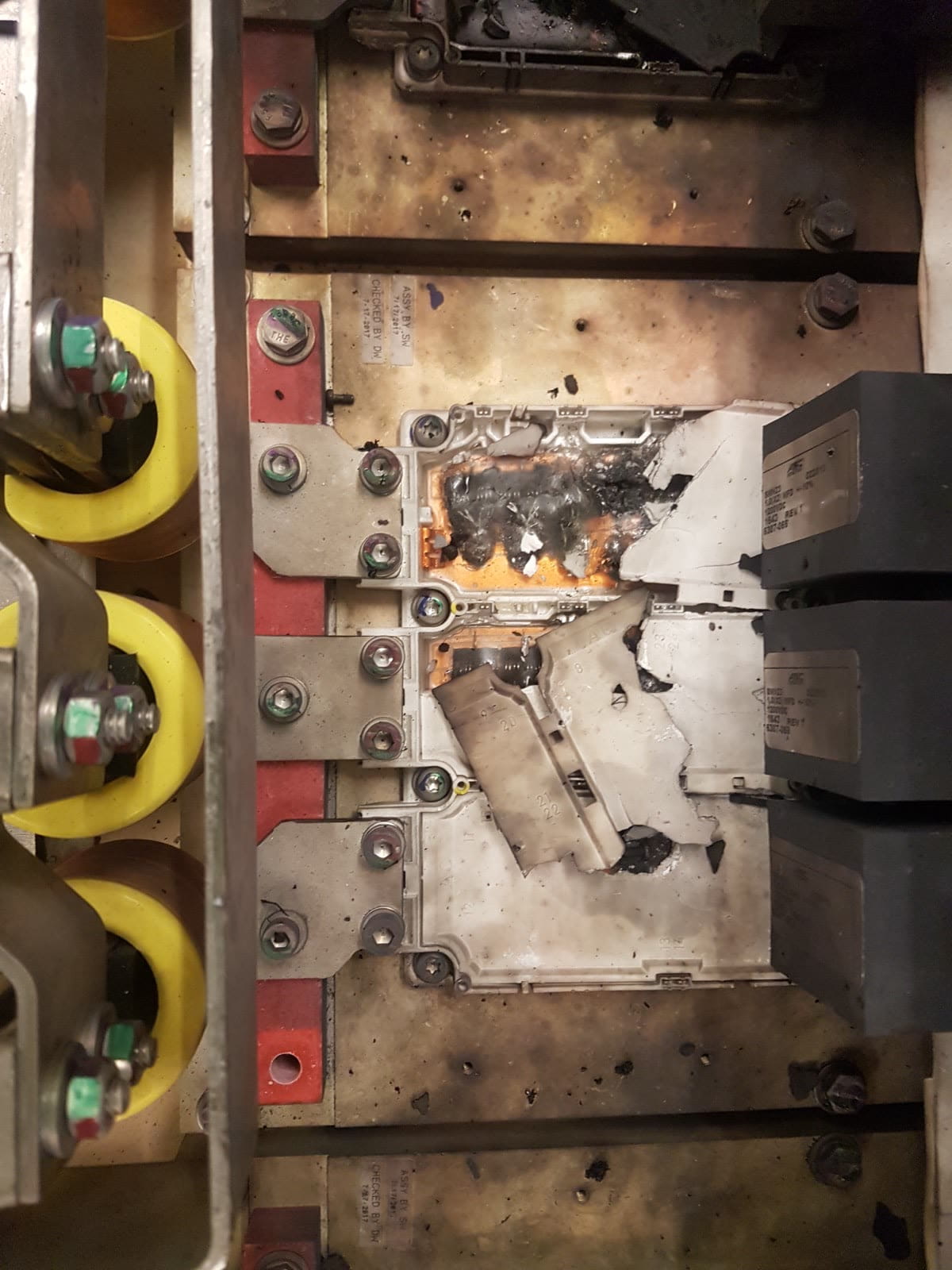
Nuisance tripping is rarely one cause. It is a variable speed drive with a tight DC bus undervoltage threshold, a supply already sagging under a neighboring load, and a harmonic spectrum that has crept up since the last expansion. Each is survivable alone. Together they take out a line, and the maintenance record blames whichever one was easiest to see.
We start by characterizing the actual power profile (harmonic assessment, flicker, fault level, protection grading) rather than by proposing hardware. Often the fix is smaller and cheaper than expected: correct grading, a tuned filter, a properly sized reactor. Sometimes the honest answer is that the site needs dynamic compensation, and then we can say so with data behind it.
Where the load itself is the disturbance, as in rolling mills, crushers, presses, welding plant and hoists, the objective inverts. The job is no longer protecting the process from the network but protecting the network from the process, which is a STATCOM problem and usually a P28 compliance one.
Where the money leaks
Voltage sags and nuisance trips
Sub-cycle disturbances that never register as outages still drop drives and controls, costing a batch, a shift, or a furnace relining.
Harmonic distortion from drive-heavy plant
Distortion overheats transformers, motors and neutrals, causes spurious protection operation, and erodes design margin invisibly until something fails.
Power factor penalties
Sites below 0.9 power factor face direct grid penalties. Where energy is 5–30% of enterprise cost, correcting it above the assessment threshold unlocks tariff rebates immediately.
Cyclic load flicker
Mills, crushers, hoists and arc equipment cause voltage fluctuation that breaches P28 limits and irritates neighboring connections, sometimes to the point of capping the site's own capacity.
Three-phase unbalance
Single-phase and asymmetric loads produce negative sequence current that heats machines and degrades efficiency across the whole plant.
Ageing switchgear with no data
Expansion after expansion, and nobody has an accurate model. Protection coordination becomes guesswork and arc flash exposure is unquantified.
The stack for this sector.
Each of these is a full solution page. The note explains how it is typically applied here.
Engineering Consultancy
Harmonic assessment, protection coordination, arc flash and fault level studies to establish what is actually happening before anything is specified.
STATCOM & SVG
Dynamic compensation for cyclic loads, with active filter and negative sequence functionality where distortion and unbalance are part of the problem.
UPS Systems
Modular LV UPS for process lines and controls, scaling to 4.8 MW, in configurations rated for dusty and corrosive plant environments.
BESS
Peak shaving against demand charges and ride-through for processes that cannot tolerate a restart.
Field Services
Commissioning, planned maintenance during shutdowns, and refurbishment of existing compensation plant.
Numbers that matter in this sector.
Work we have done here.
- Power quality investigations that traced repeat line trips to grading and harmonic interaction rather than the drive being blamed
- MV capacitor bank installations sized against published penalty thresholds with measured payback
- STATCOM deployments on cyclic industrial loads to bring flicker inside P28 limits
- Refurbishment of installed compensation plant where the original supplier had exited the market
Questions from this sector.
- How do we know whether we need a filter, a capacitor bank or a STATCOM?
- By measuring first. A harmonic and power quality assessment establishes the spectrum, the flicker level, the fault level and how the load actually varies. Slowly varying reactive demand points to switched capacitors; fast cyclic variation points to a STATCOM; a specific resonant harmonic points to a tuned filter. Guessing here is expensive in both directions.
- Will compensation invalidate our existing protection settings?
- It can, which is why protection coordination is part of the scope rather than an afterthought. Adding capacitance changes fault level and can shift grading margins, so settings are reviewed and reissued as part of the design.
- Can work be done without stopping production?
- Installation is normally planned around a shutdown window, but survey, monitoring and much of the design work happens live. Where a shutdown is unavoidable we scope it tightly and pre-stage as much as possible so the outage is hours rather than days.
We also work in these.
Data Centers
Whole-facility protection for hyperscale, colocation and enterprise sites, where the mechanical plant matters as much as the IT load.
Read moreUtilities & Grid
Voltage support, reactive compensation and grid-forming storage for substations at 220 kV and below, deployed where reinforcement is years away.
Read moreRenewables & Storage
Compliance, compensation and storage for wind, solar and BESS projects, from the G99 study pack through to the containerized asset in the substation yard.
Read moreOil & Gas
Ruggedized, containerized power systems for upstream, midstream and offshore operations where an outage is measured in production days.
Read moreWater & Wastewater
Pumping and treatment sites are energy-intensive, motor-heavy and cannot stop. A natural fit for compensation, storage and private wire supply.
Read moreMining & Metals
Rolling mills, crushers, hoists and furnaces are the most disruptive loads on any network, and the ones compensation was invented for.
Read moreTell us what keeps tripping.
Most conversations start with an event nobody can fully explain. Send us the alarm log, the single-line diagram, or just the symptom. We will tell you what we would measure first.
Let's Solve Your Power Challenge.
Connect with our engineering team for a technical consultation. We'll help you identify risks and uncover efficiency opportunities.

Renewable Energy & Drives
5325 S Moorland RdNew Berlin, WI 53151United States

Severn Drives & Energy
Units 2 & 3, Kingsley Business ParkNew Road, Kibworth BeauchampLeicestershire, LE8 0LEUnited Kingdom
Start Your Consultation
Fill out the form below and we'll be in touch.