
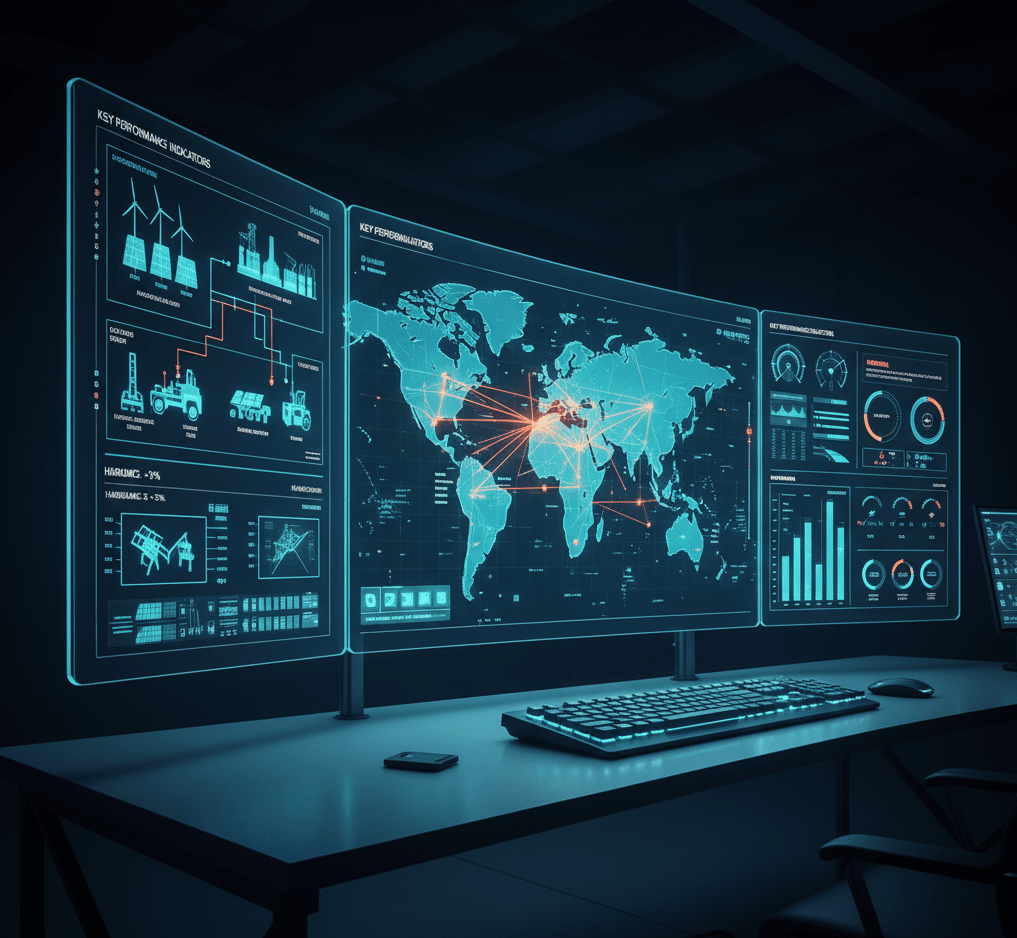
Monitoring&RemoteSupport
Most critical power failures announce themselves weeks in advance: capacitor ripple, fan current, cell impedance. Monitoring is how you hear them.
- Coverage
- 24/7
- Protocols
- Modbus, SNMP, IEC 61850
- Access
- Secure remote diagnostics
- Reach
- Global support programs
The failure was visible. Nobody was looking.
Almost nothing in a critical power system fails without warning. Electrolytic capacitors drift before they fail. Fans draw more current as bearings wear. Battery cell impedance climbs for months before a string drops a load test. What is usually missing is not the signal but someone watching for it.
Our monitoring connects to the assets we supply, and to much of what we don't, over the interfaces they already speak: Modbus, SNMP over Ethernet, CAN for battery management, dry contacts, and IEC 61850 where substation automation is in play. Where a site has no network, WiFi and 4G options put the asset online anyway.
The value is in what happens next. Secure remote diagnostics mean an engineer can inspect alarm history, waveform captures and trend data before deciding whether a site visit is needed. That usually shortens resolution from days to hours, and often removes the visit entirely.
What is monitored
Real-time health monitoring
Continuous oversight of critical power assets (converter status, thermal behavior, load profile, alarm state) across a whole estate rather than one site at a time.
Predictive fault analytics
Early identification of wear in batteries, fans and capacitors, so consumables are replaced on evidence rather than on a calendar or after a failure.
Remote access & diagnostics
Secure remote troubleshooting that shortens time to resolution and removes the majority of exploratory site visits.
Event & waveform capture
Event-triggered recording so a disturbance is analyzed from data rather than reconstructed from recollection.
Open integration
RS485, CAN for BMS, SNMP over Ethernet, dry contacts and IEC 61850, feeding your BMS, SCADA or DCIM rather than demanding another silo.
Connectivity where there is none
Optional WiFi and 4G cards bring remote or newly commissioned sites online without waiting for site IT.
Lifecycle support programs
Maintenance and support agreements shaped around operational and geographic requirements, from monitoring-only through to full response-time commitments.
Reporting that gets used
Periodic asset health reporting with ranked recommendations, written for the person who has to justify the capital as well as the one who turns the wrench.
Where this gets deployed.
- Multi-site UPS estates
- Remote and unattended substations
- Containerized assets at renewable sites
- Battery fleet health management
- Post-commissioning performance verification
- Warranty and service-level evidence
Questions we get asked most.
- Can you monitor equipment you did not supply?
- In most cases yes. If the asset exposes Modbus, SNMP, IEC 61850 or dry contacts, and nearly all modern critical power equipment does, it can be brought into the same view as the rest of the estate.
- What does the monitoring actually predict?
- The reliable early indicators are consumables and thermal behavior: battery cell impedance trends, capacitor ripple and temperature, fan current and speed response, and converter thermal margin under a given load. Those give weeks to months of warning. Monitoring will not predict a mechanical failure that has no electrical signature.
- How is remote access secured?
- Remote access is scoped and authenticated per site, with connections established under the customer's own network policy. We work with site IT to agree the architecture rather than requiring inbound access, and for sites where remote connectivity is not permitted we run monitoring in local-log-and-report mode instead.
- Does this replace on-site maintenance?
- No. It makes it better targeted. Physical inspection, torque checks and battery capacity testing still need hands on the equipment. What monitoring changes is that a visit arrives knowing what it is looking for, and with the right parts already on the van.
Usually specified alongside this.
Field Services
Commissioning, FAT/SAT, preventive maintenance, repairs and refurbishment, including legacy PureWave and DSTATCOM fleets the original manufacturer no longer supports.
Read moreSystemsUPS Systems
Modular low-voltage UPS from 50 kW to 4.8 MW, and medium-voltage PureWave UPS to 22.5 MW at 5–25 kV. Both protect the whole facility, not one row of racks.
Read moreSystemsBESS
Grid-forming storage customised to any size, with standard configurations from 365 kWh cabinets to 50 MWh medium-voltage blocks. Cascaded topology, liquid cooled, sub-5 ms response, no station transformer.
Read moreSend us the single-line diagram.
We would rather look at your actual system than send you a generic proposal. Share the drawing, the constraint you are working against, and the date you need it working by.
Let's Solve Your Power Challenge.
Connect with our engineering team for a technical consultation. We'll help you identify risks and uncover efficiency opportunities.

Renewable Energy & Drives
5325 S Moorland RdNew Berlin, WI 53151United States
Severn Drives & Energy
Units 2 & 3, Kingsley Business ParkNew Road, Kibworth BeauchampLeicestershire, LE8 0LEUnited Kingdom
Start Your Consultation
Fill out the form below and we'll be in touch.