
Utilities&GridOperators
Networks are being asked to carry more variable generation on infrastructure sized for a different century. Compensation and storage buy capacity and stability without waiting for reinforcement.
- Substations
- 220 kV and below
- Compensation
- To 30 Mvar per bank
- Storage
- To 50 MWh per block
- Integration
- IEC 61850 / 60870-5
Reinforcement is years away. The constraint is now.
Distributed generation, electrification of heat and transport, and the loss of synchronous inertia have all landed on networks that were planned around a very different load shape. The structural answer is reinforcement, and it is both correct and slow. The operational answer, in the meantime, is to make existing assets do more.
Reactive compensation returns the most per pound spent. Automatically switched capacitor banks working with reactive power automatic control regulate bus voltage and improve voltage qualification rate at substations up to 220 kV, interfacing directly with integrated substation automation for unattended operation. Where the variation is dynamic, STATCOM handles what switched plant cannot.
Grid-forming storage adds the other half: virtual inertia, black start capability, and the ability to hold an islanded section up while distributed generation reconnects. That is exactly the operating mode a fault-isolated feeder needs, and the platform is designed for it.
The operational reality
Voltage regulation on weak feeders
Long rural feeders with embedded generation swing outside statutory limits in both directions, and mechanically switched plant cannot follow the change.
Declining system inertia
As synchronous plant retires, frequency excursions get steeper. Grid-forming storage that emulates rotating inertia replaces some of what is being lost.
Restoration times after faults
Fault location on long feeders is difficult and outages persist. Storage capable of black start allows an isolated section to be re-energized locally while the fault is found.
Connection queue and capacity constraint
Compensation and storage can release usable capacity on existing circuits, deferring reinforcement that would otherwise be the only path.
Power quality from connected generation
Every new connection brings a harmonic and flicker contribution. Compliance assessment and mitigation determine whether it can be accepted.
Unattended operation
Remote substations need plant that integrates with automation and SCADA and reports its own health, because nobody is walking past it.
The stack for this sector.
Each of these is a full solution page. The note explains how it is typically applied here.
STATCOM & SVG
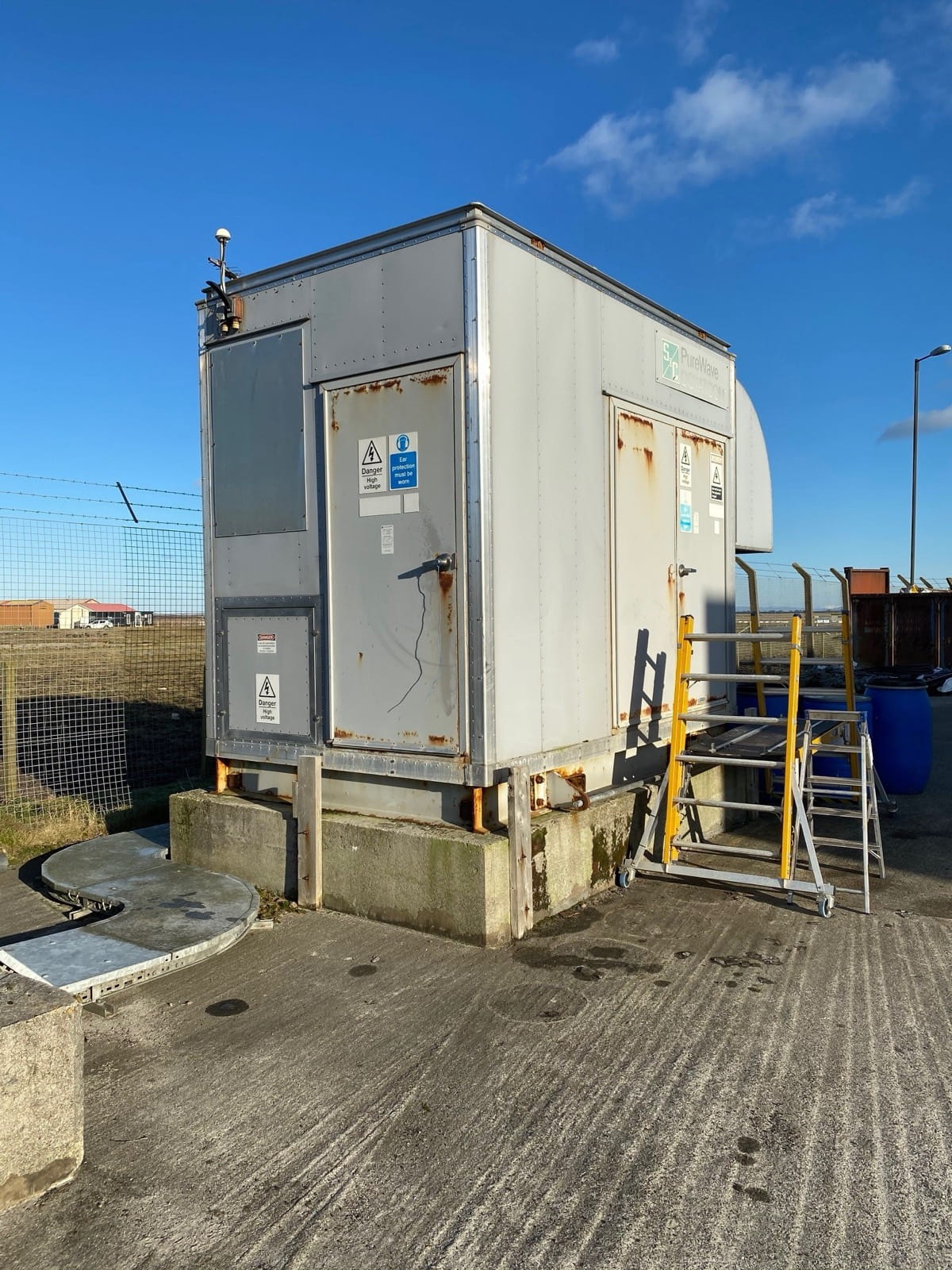
MV SVG to 55 kV and PureWave DSTATCOM for distributed, phaseable transmission voltage support inside existing substations.
BESS
Grid-forming storage to 50 MWh with virtual inertia, 3 pu overload for 10 seconds and black start capability.
Engineering Consultancy
Connection assessment, protection coordination, P28 and G5 compliance and EMT studies for network reinforcement and new connections.
Monitoring & Support
Remote asset health for unattended sites, integrated into existing SCADA rather than a parallel system.
Field Services
Commissioning, planned maintenance and refurbishment across dispersed substation estates.
Numbers that matter in this sector.
Work we have done here.
- Containerized compensation deployed at remote wind farm substations across Scotland and northern England
- Legacy DSTATCOM refurbishment returning transmission voltage support assets to service
- Grid-forming storage supporting islanded operation and black start of a fault-isolated distribution section
- Connection studies delivered in the operator's own format to shorten the objection cycle
Questions from this sector.
- Can compensation defer reinforcement?
- Frequently, yes. Reactive compensation reduces transmission losses and increases usable transmission capacity on existing circuits. Whether that fully substitutes for reinforcement depends on the binding constraint. A thermal limit will not be solved by reactive support; a voltage limit often will.
- How does distributed compensation compare to one central asset?
- Land acquisition for large, centrally located compensating assets is difficult and expensive, and a single interconnection often limits effectiveness to a narrow range of contingency events. Distributed units deployed inside existing substations respond across a wider range of contingencies, allow redundancy, and let a program be phased over several years rather than funded in one capital event.
- Do you work directly with DNOs and TOs?
- Yes, both as an equipment supplier and as the consultancy producing the studies behind a connection application. Our studies are issued in the format the operator expects, which materially shortens the review cycle.
We also work in these.
Data Centers
Whole-facility protection for hyperscale, colocation and enterprise sites, where the mechanical plant matters as much as the IT load.
Read moreIndustrial & Manufacturing
Power quality engineering for production lines where a one-cycle disturbance costs a shift: semiconductor, battery, automotive, pharma and food.
Read moreRenewables & Storage
Compliance, compensation and storage for wind, solar and BESS projects, from the G99 study pack through to the containerized asset in the substation yard.
Read moreOil & Gas
Ruggedized, containerized power systems for upstream, midstream and offshore operations where an outage is measured in production days.
Read moreWater & Wastewater
Pumping and treatment sites are energy-intensive, motor-heavy and cannot stop. A natural fit for compensation, storage and private wire supply.
Read moreMining & Metals
Rolling mills, crushers, hoists and furnaces are the most disruptive loads on any network, and the ones compensation was invented for.
Read moreTell us what keeps tripping.
Most conversations start with an event nobody can fully explain. Send us the alarm log, the single-line diagram, or just the symptom. We will tell you what we would measure first.
Let's Solve Your Power Challenge.
Connect with our engineering team for a technical consultation. We'll help you identify risks and uncover efficiency opportunities.

Renewable Energy & Drives
5325 S Moorland RdNew Berlin, WI 53151United States
Severn Drives & Energy
Units 2 & 3, Kingsley Business ParkNew Road, Kibworth BeauchampLeicestershire, LE8 0LEUnited Kingdom
Start Your Consultation
Fill out the form below and we'll be in touch.