
STATCOM&StaticVarGeneration
Dynamic reactive power that responds in milliseconds: stabilizing weak voltage, killing flicker, and riding through faults instead of tripping out during them.
- Standard LV platform
- 1200 – 3600 kvar
- Standard MV platform
- 6 – 55 kV
- Response
- From 5 ms
- Ride-through
- Faults to 250 ms
Capacitors switch. STATCOMs respond.
A switched capacitor bank corrects a slowly varying power factor well and cheaply. It cannot do anything about an arc furnace striking, a crusher starting, or a wind farm's output stepping. Those events move in cycles, not minutes. For those, you need a converter that can source or sink reactive power continuously and reverse in milliseconds.
Our STATCOM platform is built on three-level IGBT technology. Using twelve IGBTs where a conventional two-level design uses six halves the voltage stress on each semiconductor, which lowers losses, allows a higher DC link voltage, and generates the higher peak currents needed to filter harmonics across a wider bandwidth. The third switching state also cuts output current ripple, so the network and EMC filters get smaller at the same switching frequency.
Under fault, it stays on. Disturbances lasting up to 250 ms do not shut the system down. That is the difference between supporting the network through an event and becoming another thing the network has to recover.
Compensation functions
Voltage regulation
Stabilizes weak system voltage and holds the receiving-end level, strengthening voltage stability during and after network faults.
Dynamic power factor correction
Continuously variable capacitive and inductive output at the grid connection, holding power factor above penalty thresholds as load swings.
Harmonic compensation
Optional active filter functionality across the 2nd to 51st harmonic at 50 Hz, or 2nd to 41st at 60 Hz, with low intrinsic emissions thanks to built-in active compensation.
Negative sequence compensation
Rebalances three-phase unbalance from single-phase and asymmetric loads such as traction supplies and welding plant.
Flicker mitigation
Suppresses voltage fluctuation and flicker from cyclic loads (rolling mills, crushers, hoists, arc equipment) where P28 limits are the binding constraint.
Fault ride-through
Faults with a duration of up to 250 ms do not cause a shutdown, so the compensation stays available through the disturbance and the recovery.
Layered redundancy
Redundancy at both the power module and individual IGBT power unit level, with modular construction that keeps a failure local and a repair short.
Loss reduction & capacity release
Reduces transmission losses and increases usable transmission capacity, often deferring reinforcement that would otherwise be the only alternative.
Platforms
Two families, plus the PureWave DSTATCOM line for distributed transmission-level voltage support.
RE&D STATCOM
3-level IGBT · to ±3600 kvar · 3–35 kV
Modular platform built from IGBT power units rated 125 A at up to 690 V, combined into ±600 kvar power modules. Up to six modules form a complete system, with an integrated control cabinet and circuit breaker.
- Rated voltage
- 3 kV – 35 kV with matching transformer
- Compensation
- 1200 / 1800 / 2400 / 3000 / 3600 kvar
- Rated current at 690 V
- 1000 A – 3000 A
- Inverter
- 3-level IGBT, DC film capacitor link
- Switching frequency
- 10 kHz, low-loss design
- Power loss
- < 2.1% of maximum, < 1.8% typical, < 0.4% idle
- Response time
- Typically 10 – 40 ms
- Active filter
- Optional, 2nd–51st harmonic (50 Hz)
- Cooling
- Variable-speed air, or optional liquid
- Protection
- IP20 standard, IP21–IP54 optional
- Expandability
- Up to 6 modules (2-winding), 2 × 6 (3-winding)
- Standards
- EN 50178, EN 61439-1/-2, EN 61000-6-2/-6-4, EN 55011 Class A1
SVG STATCOM Line
Medium voltage · 6–55 kV · to 200 Mvar tested
Cascaded medium-voltage static var generator for utility, traction, metallurgical and renewable applications, connecting directly at distribution voltage. Every unit is full-load tested before shipment.
- Rated voltage
- 6 / 10 / 27.5 / 35 / 55 kV, 1-ph or 3-ph
- Nominal voltage tolerance
- < 120%
- Response time
- Up to 5 ms
- Power factor
- > 0.95
- Design life
- 20 years · MTBF > 75,000 h · MTTR < 5 min
- Compensation modes
- Reactive, harmonic current, negative sequence, comprehensive
- Control
- PWM current tracing, DC voltage balancing, closed-loop DC current
- HV isolation
- Fibre optic communication
- Cooling
- Air or water cooling
- Protocol
- Modbus, open standardized interface
- Factory test
- 100% power unit full-load and high-temperature aging test
PureWave DSTATCOM
Distributed transmission voltage support
Inverter-based distributed static compensation for transmission systems, delivering leading or lagging VARs in a fraction of a cycle. Deployable in existing substations, so projects can be phased rather than built as a single large central asset.
- Function
- Fast-compensating distributed reactive source
- Response
- Sub-cycle, far faster than mechanically switched plant
- Siting
- Deployable within existing substations
- Integration
- Can also operate mechanically switched capacitor banks
- Benefit
- Shortened voltage recovery time and improved line capacity utilization
- Support
- Legacy fleet supported by RE&D with spares and field service
Where this gets deployed.
- Wind and solar plant grid-code compliance
- Rolling mills, crushers and other cyclic industrial loads
- Rail and traction supplies with negative sequence unbalance
- Mining and cement plant voltage support
- Long-distance transmission voltage stabilization
- Offshore and marine distribution
- Paper, testing facilities and logistics automation
Literature & datasheets
Download the current product literature, or browse the full catalog including legacy and discontinued systems.
Questions we get asked most.
- STATCOM or capacitor bank?
- If the reactive demand varies slowly and predictably, a switched capacitor bank is the cheaper and simpler answer. If it varies in cycles (arc furnaces, crushers, traction, renewable output steps) a STATCOM is the only thing fast enough. Many sites use both: capacitors for the bulk correction, a STATCOM for the dynamic component.
- Why three-level rather than two-level?
- A three-level circuit uses twelve IGBTs where a two-level design uses six, halving the voltage load on each semiconductor. That means lower losses, tolerance of a higher intermediate circuit voltage, higher achievable peak currents for wider-bandwidth harmonic filtering, and lower output current ripple, which in turn lets the network and EMC filters be smaller at the same switching frequency.
- How fast does it respond?
- The medium-voltage SVG platform responds in up to 5 ms. The three-level LV platform is application-dependent and typically responds in 10 to 40 ms. Both are orders of magnitude faster than mechanically switched compensation.
- Will it stay running through a network fault?
- Yes. Faults with a duration up to 250 ms do not cause the STATCOM to shut down. That fault ride-through capability is usually a grid code requirement for connected generation, and it is what makes the system useful during a disturbance rather than just after one.
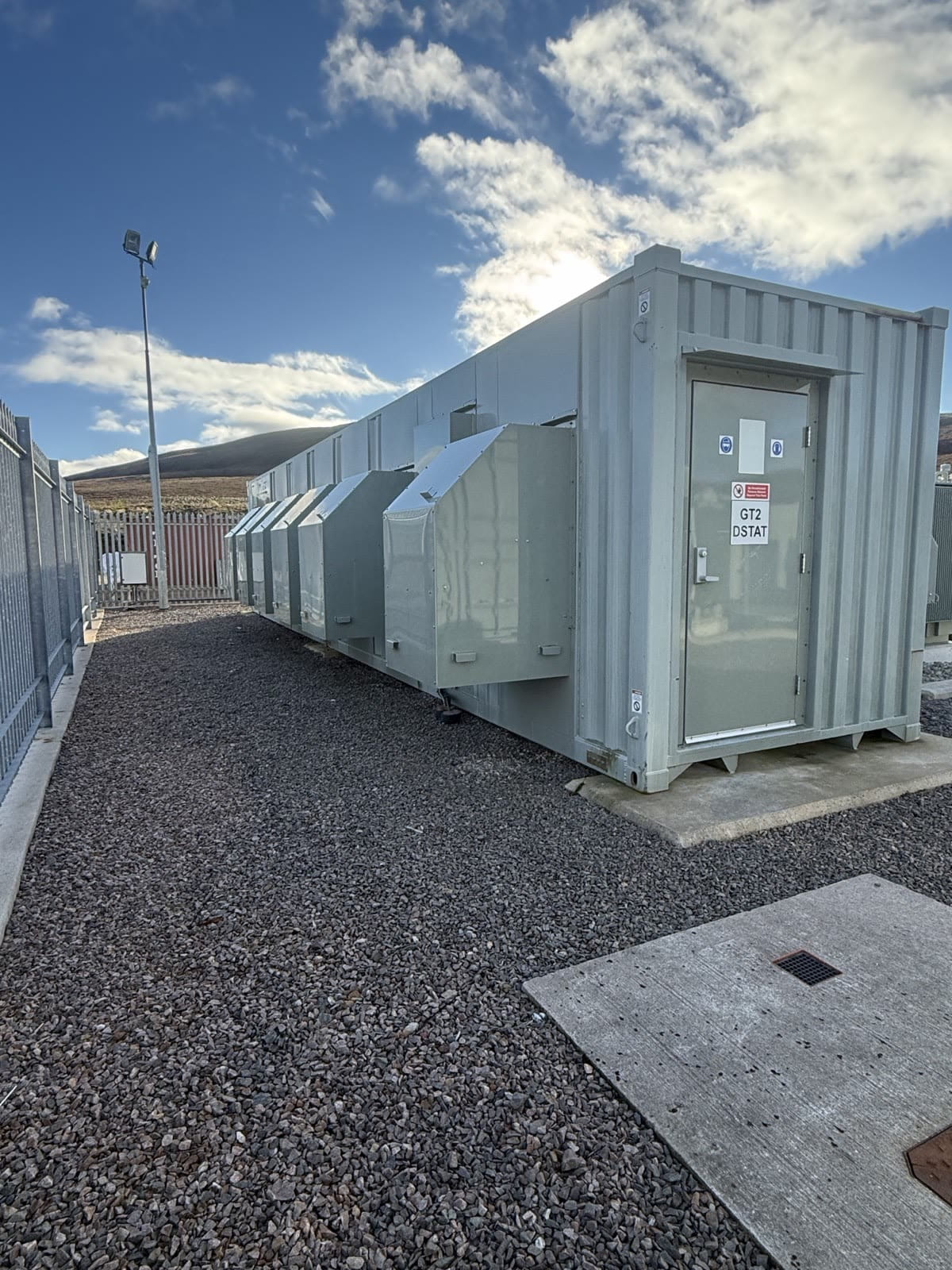
- Can it be containerized for a remote substation?
- Yes. Containerized STATCOM is one of the configurations we deploy most often, particularly at wind and solar substations where there is no building. The system is factory-assembled and full-load tested before shipment, then craned into position and commissioned on site.
Usually specified alongside this.
BESS
Grid-forming storage customised to any size, with standard configurations from 365 kWh cabinets to 50 MWh medium-voltage blocks. Cascaded topology, liquid cooled, sub-5 ms response, no station transformer.
Read moreServicesEngineering Consultancy
Grid-code compliance, protection coordination and power system studies, modelled in DIgSILENT PowerFactory and signed off by chartered engineers.
Read moreSend us the single-line diagram.
We would rather look at your actual system than send you a generic proposal. Share the drawing, the constraint you are working against, and the date you need it working by.

Let's Solve Your Power Challenge.
Send an enquiry to our engineering team. We'll help you identify risks and uncover efficiency opportunities.

Renewable Energy & Drives
5325 S Moorland RdNew Berlin, WI 53151United States
Severn Drives & Energy
Units 2 & 3, Kingsley Business ParkNew Road, Kibworth BeauchampLeicestershire, LE8 0LEUnited Kingdom
Send an enquiry
Fill out the form below and we'll be in touch.