
Mining,Metals&HeavyIndustry
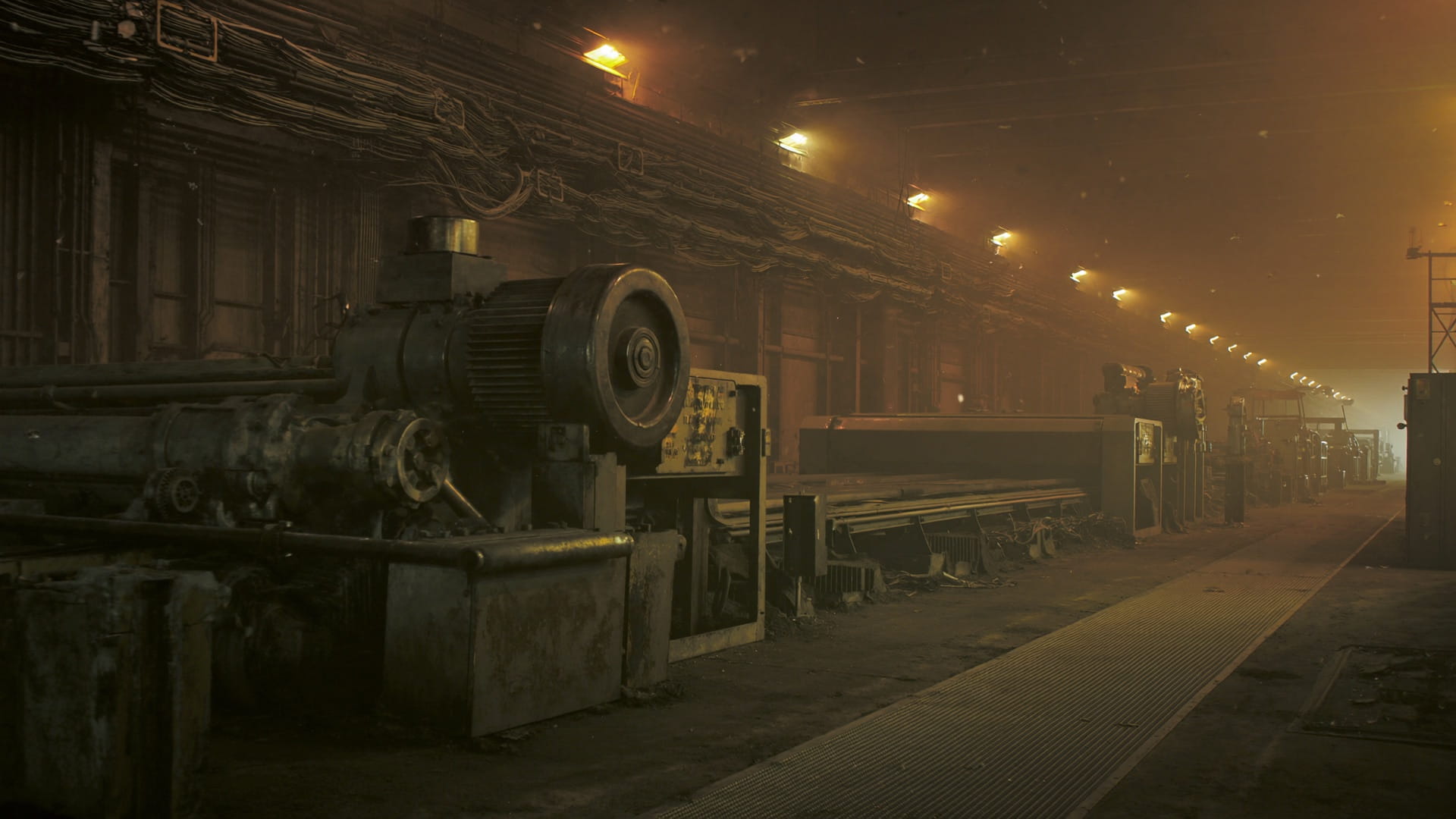
Rolling mills and crushers do not draw power, they punch it. Compensation here buys you permission to keep running at full capacity, which is worth far more than the efficiency saving.
- Energy cost
- 5–30% of enterprise cost
- Compensation
- To 3600 kvar per system
- Response
- 5 ms
- Functions
- Flicker, harmonic, unbalance
Your connection size is set by how badly you disturb the network.
Metallurgy, mining and cement sites carry energy costs of 5 to 30% of total enterprise cost, and sites below 0.9 power factor face grid penalties on top. That alone justifies compensation. But for heavy cyclic plant the more binding issue is usually connection capacity: flicker and unbalance limits determine how much load the network will accept, which determines how much production is possible.
Rolling mills, crushers, hoists, presses and arc equipment produce exactly the disturbance profile that switched compensation cannot address: fast, repetitive and often asymmetric. STATCOM was developed for this duty, and the three-level platform provides the peak current capability needed for wide-bandwidth harmonic filtering alongside the reactive response.
Negative sequence compensation matters here too. Single-phase and asymmetric loads produce unbalance that heats machines across the whole plant and degrades efficiency invisibly. The same asset corrects reactive power, harmonics and unbalance rather than requiring three separate solutions.
What the load does to the network
Flicker breaching P28 limits
Cyclic loads cause voltage fluctuation that can constrain how much capacity the network will grant, capping production before the plant does.
Power factor penalties
Below 0.9, grid penalties apply directly. Against energy costs of 5–30% of enterprise cost, correction pays back against the tariff alone.
Three-phase unbalance
Asymmetric and single-phase loads generate negative sequence current that heats motors and transformers and degrades plant-wide efficiency.
Harmonic distortion
Drive-heavy and rectifier plant distorts the waveform, causing overheating and spurious protection operation across the site.
Voltage depression on starting
Crushers, mills and hoists depress voltage on starting, tripping adjacent equipment and interrupting continuous processes.
Extreme duty environments
Dust, vibration, temperature and mechanical shock destroy equipment specified to office-grade assumptions.
The stack for this sector.
Each of these is a full solution page. The note explains how it is typically applied here.
STATCOM & SVG
Three-level IGBT STATCOM and MV SVG sized to the plant, correcting reactive power, harmonics and negative sequence from one asset.
Engineering Consultancy
P28 flicker studies, G5 harmonic assessment, protection coordination and arc flash analysis for the plant as it actually runs.
UPS Systems
Protection for control systems and critical auxiliaries, in enclosures specified for dusty and abrasive environments.
Field Services
Commissioning and maintenance scheduled around planned shutdowns, plus refurbishment of ageing compensation plant.
Monitoring & Support
Condition monitoring on compensation assets working under severe duty cycles.
Numbers that matter in this sector.
Work we have done here.
- Compensation deployed on rolling mill, mining and cement applications
- Traction and testing facility installations correcting negative sequence unbalance
- Full-load factory testing on every power unit before shipment, up to 200 Mvar complete-set capability
- Refurbishment of installed compensation plant on sites where replacement would have forced an extended outage
Questions from this sector.
- Will compensation let us connect more load?
- Often, yes, where flicker or voltage limits are what is capping your connection rather than a thermal limit. A P28 study establishes which constraint is binding. If it is flicker, dynamic compensation directly addresses it; if it is thermal, it will not, and we will tell you that before you spend anything.
- Can one asset handle reactive power, harmonics and unbalance?
- Yes. The STATCOM platform provides reactive power compensation, harmonic current compensation and negative sequence compensation, with a comprehensive mode combining them. Whether one asset is correctly sized for all three at your site is a study question, not a catalogue one.
- How well does this equipment hold up in a dusty plant?
- Enclosures are available from IP20 through to IP54, with three-proof coating processes for long-term operation in harsh environments, and variable-speed air or liquid cooling depending on ambient conditions. The specification is set against your actual environment rather than a standard assumption.
We also work in these.
Data Centers
Whole-facility protection for hyperscale, colocation and enterprise sites, where the mechanical plant matters as much as the IT load.
Read moreIndustrial & Manufacturing
Power quality engineering for production lines where a one-cycle disturbance costs a shift: semiconductor, battery, automotive, pharma and food.
Read moreUtilities & Grid
Voltage support, reactive compensation and grid-forming storage for substations at 220 kV and below, deployed where reinforcement is years away.
Read moreRenewables & Storage
Compliance, compensation and storage for wind, solar and BESS projects, from the G99 study pack through to the containerized asset in the substation yard.
Read moreOil & Gas
Ruggedized, containerized power systems for upstream, midstream and offshore operations where an outage is measured in production days.
Read moreWater & Wastewater
Pumping and treatment sites are energy-intensive, motor-heavy and cannot stop. A natural fit for compensation, storage and private wire supply.
Read moreTell us what keeps tripping.
Most conversations start with an event nobody can fully explain. Send us the alarm log, the single-line diagram, or just the symptom. We will tell you what we would measure first.
Let's Solve Your Power Challenge.
Connect with our engineering team for a technical consultation. We'll help you identify risks and uncover efficiency opportunities.

Renewable Energy & Drives
5325 S Moorland RdNew Berlin, WI 53151United States

Severn Drives & Energy
Units 2 & 3, Kingsley Business ParkNew Road, Kibworth BeauchampLeicestershire, LE8 0LEUnited Kingdom
Start Your Consultation
Fill out the form below and we'll be in touch.