Quick answer
A burned-out DSTATCOM inverter section can be rebuilt on site when the frame is structurally sound and the original drawings are available. After an arc fault destroyed one of a utility customer's inverter sections, we stripped it to the frame, dry ice cleaned it, reordered every component including custom-made bus bars, and rebuilt it in place in about a month. The alternative would have meant removing seven healthy inverters to ship one damaged section to a factory. The rebuilt inverter came back online with no issues.
Key takeaways
- A loose breaker connection arced, caught fire, and destroyed an entire DSTATCOM inverter section from top to bottom.
- The factory-repair route would have meant removing seven healthy inverters just to reach the one damaged section.
- Rebuilding on site from the original drawings took about a month, including remanufactured custom bus bars, and the inverter returned with no issues.
The breaker had a loose connection. That is all it took.
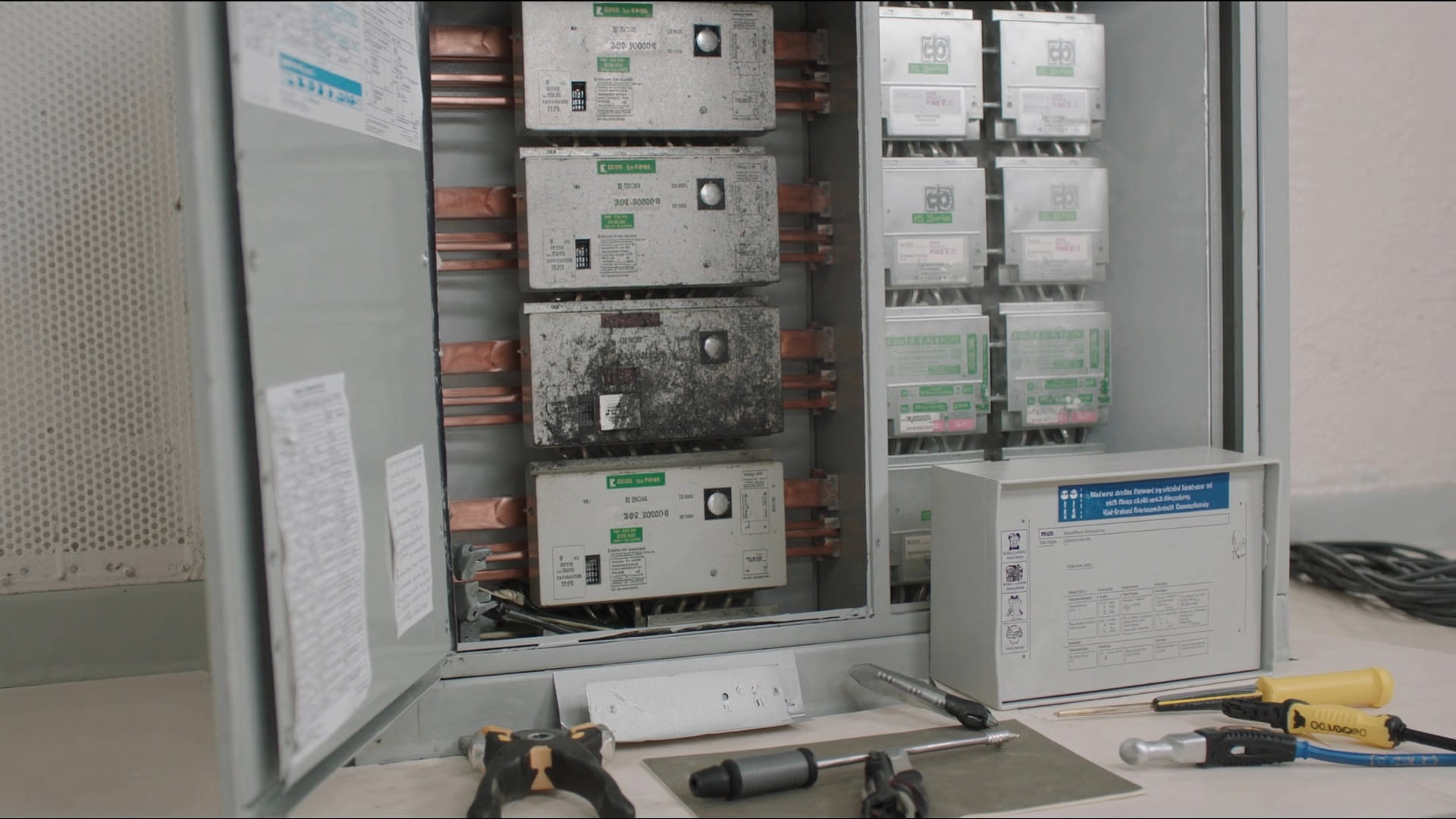
The loose joint arced, the arc caught fire, and by the time it was over, an entire inverter section of a utility customer's DSTATCOM had burned from top to bottom. Two inverters built into one section, the AC breakers, and hundreds of supporting components, most of it trashed.
The textbook answer to damage like this is to disconnect the whole section and ship it back to a factory for a rebuild. On this site, the textbook answer was somewhere between impractical and absurd. So we rebuilt it where it stood, and the finished inverter came back online without an issue. Here is the full story, including the decision that mattered most.
The starting point: a fleet at half capacity
This customer had brought us in to refurbish an aging fleet of DSTATCOMs. Years of service had taken the fleet down to roughly half the output it was rated for, and the customer needed it back at full strength. Our refurbishment program recovered the fleet to about 90 percent. The last stretch came down to a single inverter: the one that had burned.
A DSTATCOM, if you have not met one, is a power electronics system that injects or absorbs reactive power to hold voltage steady on a distribution network. We have covered how DSTATCOMs solve voltage sags and how STATCOMs keep the grid steady before. What matters for this story is that these are dense, engineered assemblies. A single section can hold hundreds of components: the power semiconductor stacks that do the switching, capacitors, breakers, custom bus bars, even glass insulators.
Why "send it to the factory" didn't work here
Factory rebuilds exist for a reason. Rebuilding a burned inverter section in the field is genuinely difficult, and most service organizations will not attempt it.
But look at what the factory route would have demanded on this site. The damaged inverter sat at the back of a lineup, with seven other inverters installed in front of it. Extracting the burned section meant removing seven healthy, working inverters just to reach the one that had failed, then shipping the section away and reversing the whole exercise months later.
That plan fails on three counts:
- Cost. Removing and reinstalling seven healthy inverters is a project in itself, on top of the factory rebuild.
- Risk. Every disconnection and reconnection of working equipment is a fresh opportunity to introduce faults into inverters that had nothing wrong with them.
- Time. The system would have run degraded for the entire round trip.
Repairing in place avoided all three. It was the cheaper option, the lower-risk option, and the option that kept the rest of the fleet untouched. The catch was that we had to do the difficult thing: a component-level rebuild in the field.
The rebuild, step by step
Strip-out. The team removed every damaged component from the section until only the frame remained. A space that normally holds hundreds of parts was emptied completely.
Cleaning. Fire leaves conductive soot and debris everywhere. The section was dry ice blasted, a cleaning method that lifts contamination without moisture or abrasive residue, which matters when the surfaces will carry medium-voltage equipment again.
Sourcing every single part. We went through the original drawings line by line and ordered everything the rebuild required, from capacitors and breakers down to nuts, bolts, and insulators. The bus bars were the awkward part. Bus bars in a system like this are custom-made for the application; you cannot pick them up from a distributor. They had to be remanufactured to the drawings.
Building from the ground up. With parts on hand, the team assembled the section from scratch: bus work, wiring, breakers, power stages, all of it, in place on site. End to end, the job took about a month.
Return to service. The rebuilt inverter was tested, energized, and brought back online. No issues at startup, and no issues since. The fleet got its final stretch of capacity back.
What this says about repair versus replace
It would have been easy to declare the section a write-off. Fire damage looks terminal, and a factory return was the established playbook. But the decision came down to data and drawings, not appearances. The frame was sound, the design was documented, and every damaged component was identifiable and orderable. That made a full on-site rebuild an engineering exercise rather than a gamble.
This is the approach we bring to most failures in the field: repair and refurbishment first, full replacement only when the numbers genuinely point that way. The same thinking applies when a failure looks like an equipment defect but might not be; that is a job for power quality root cause analysis before anyone spends money on the wrong fix. And when the stranded part is not the electronics but the batteries, the logic holds too, as in our Kokam battery replacement work.
Damaged or failed inverter section? Send us the fault description and photos and we will say whether an on-site rebuild is viable and roughly what it costs. Email sales@renewable-d.com or call +1 414 562 6559 (US) or +44 116 279 6131 (UK).
Frequently asked questions
Can a burned-out inverter section really be rebuilt on site?
Yes, when the frame is structurally sound and the original drawings are available. The rebuild becomes a matter of stripping the section, cleaning it properly, sourcing or remanufacturing every component including custom items like bus bars, and reassembling to the original design. It is demanding work, but it avoids removing healthy equipment to extract the damaged section.
When is an on-site rebuild better than a factory repair?
When access is the problem. If reaching the damaged section means dismantling healthy equipment around it, the factory route multiplies cost, adds months of degraded operation, and risks introducing new faults into systems that were working. An on-site rebuild keeps the disruption contained to the equipment that actually failed.
What is a DSTATCOM?
A distribution static compensator: a power electronics system connected to a distribution network that injects or absorbs reactive power to stabilize voltage. Utilities and industrial sites use them to correct voltage sags, flicker, and other power quality problems.
Tags
Working on a project like this?
Talk to our engineering team about your site, your grid connection or your power quality problem.
Get in touch