Quick answer
A private wire is a dedicated electrical connection that delivers power from a generator directly to a private consumer instead of through the public grid. It can run islanded from the grid or in parallel with an existing grid connection. Building one requires controlled power flow, protection coordination, metering, and power quality management at the point of connection. In the US the same idea is usually called behind-the-meter power.
Key takeaways
- A private wire connects local generation directly to local demand, either islanded from the grid or in parallel with it.
- Generators earn more than grid export; consumers pay less than grid supply and gain security of supply.
- The hard part is engineering, not paperwork: controlled power flow, protection coordination, metering, and power quality at the connection.
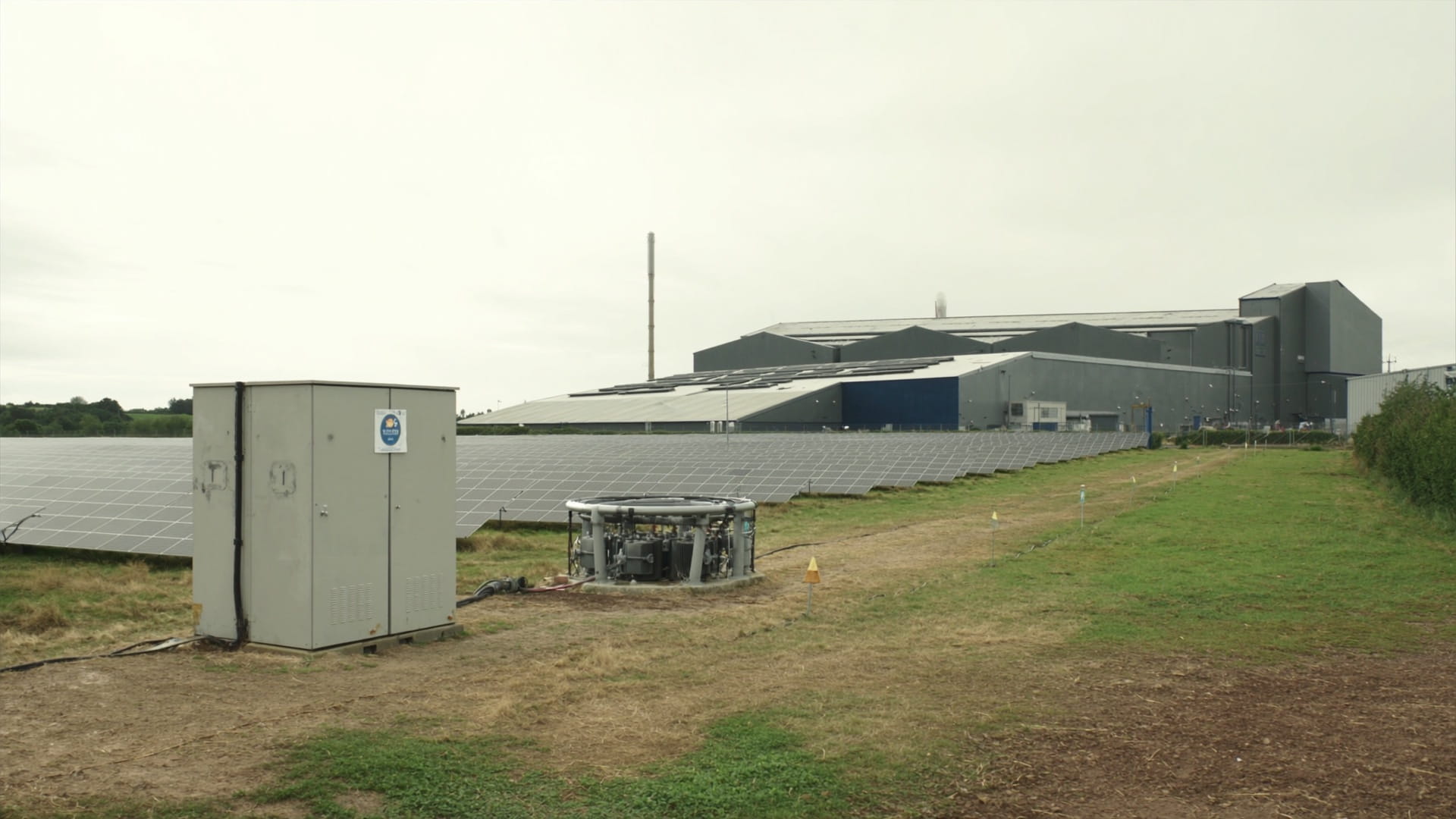
A solar farm sits on one side of the fence. A factory that buys expensive grid electricity sits on the other. Connecting the two directly, so the factory runs on power generated a field away, is called a private wire, and it is one of the most sensible arrangements in the energy industry.
It is also one of the least understood. Most people who work around energy know private wire exists as a concept. Far fewer know how one actually gets built, what has to be in place for it to work, or which companies deliver them. This post answers those questions.
What a private wire is
A private wire connects local generation directly to local demand: a solar farm supplying a factory, a wind site feeding an industrial estate, generation on one side of the boundary serving a consumer on the other. Instead of exporting every megawatt-hour into the public grid and the consumer buying it back through a supplier, the generator delivers part or all of its output straight to the consumer over a dedicated connection.
That connection can operate two ways:
- Islanded, running independently of the public grid entirely.
- Dual connection, running in parallel with an existing grid connection. Power flow between the generator and the consumer is defined and controlled, and the grid supplies whatever the private wire does not.
In the US, the same basic idea usually goes by behind-the-meter power, and it is a big part of how data center developers are getting around long grid interconnection queues: put generation next to the load and connect them directly.
When a private wire becomes a private grid
A single private wire joins one generator to one consumer. The same idea scales. Connect several generators and several consumers over dedicated infrastructure and you have a private wire network, sometimes called a private grid: an industrial estate fed by a solar farm and a battery, or a cluster of facilities sharing one generation site. The engineering questions do not change, they multiply. Power flow needs managing across every branch, protection has to work for every combination of sources, and the metering has to record what each party supplies and takes. Private wire networks are delivered by the same firms that build single private wires, with the same equipment doing the controlling.
Why generators and consumers both want one
The arrangement works because both sides come out ahead.
For the generator, supplying a private consumer earns a higher unit value than conventional export to the public grid. Project revenue improves, and the generator keeps flexibility over how much energy goes to the private consumer versus the grid.
For the consumer, locally generated electricity over a dedicated wire typically costs less per unit than grid supply. It also reduces exposure to grid pricing and network constraints, and improves security of supply. For power-hungry facilities staring at multi-year connection queues, a private wire can simply be the fastest route to the capacity they need.
What it takes to actually build one
This is the part that rarely gets explained, and it is where private wire projects succeed or stall. Between the generator and the consumer sits a set of engineering problems that someone has to own.
Controlled power flow. The defining feature of a working private wire is that power goes where it is supposed to go, and nowhere else. That means actively managing the transfer between generation and load, and physically preventing unintended export beyond the private connection. "The power stays on our wire" has to be a property of the hardware, not a policy.
Voltage and frequency management. The consumer's equipment expects clean, stable supply whether the source is the grid or a solar farm behind a hedge. Voltage and power quality at the point of connection have to be controlled, not hoped for, and in islanded operation there is no grid to lean on.
Reactive power compensation. No connection is electrically perfect. The cables and transformers between the two sites pull the voltage around as the load changes, so the connection needs reactive power control to hold it steady, or the supply at the consumer's end suffers.
Protection coordination and safe paralleling. Where the private wire runs alongside a grid connection, the two sources have to coexist without protection systems misreading each other, and faults must clear correctly on both sides. Our post on protection coordination in grid integration explains why this is a discipline of its own.
Metering and compliance. Energy changing hands needs metering both sides can trust at the point of transfer, and the whole installation has to meet the network operator's requirements for voltage, frequency, harmonics, and safety. There is a commercial and regulatory side too, which varies by country and project structure; the practical advice is to bring those questions to your advisors early, in parallel with the engineering, not after the design is fixed.
None of this is exotic. But it is specialist work, and grid connection projects have a habit of running late even without a private arrangement layered on top. We wrote about why grid connection projects get delayed, and every reason in that post applies here.
Who builds private wires?
In most conversations we have about private wire, the sticking point is not "is this possible?" but "who actually does this?"
The answer is power engineering firms that can design and deliver the connection end to end, and there are not many of them. The work spans point-of-connection design, power electronics, protection, and commissioning against the network operator's requirements. It is the same skill set behind grid connection engineering generally, applied to a two-party network instead of a public one.
GridLink is our packaged answer. The system is built around a power electronics converter that regulates active power flow from generator to consumer. It controls voltage and power quality at the point of connection, manages the power transfer between generation and load, prevents unintended export beyond the private connection, and provides the reactive power control that holds voltage steady across the connection. Power flows one way, within the defined private network, by design.
The system ships as a modular, factory-assembled unit for outdoor installation next to existing high-voltage infrastructure, supports both islanded and dual-connection operation, and can be adapted to different network voltages, generation technologies, and consumer loads without fundamental redesign. When circumstances change later, the arrangement can change with them.
The same questions surface for buyers acquiring generation assets that already have private arrangements attached, which is one more reason technical due diligence when a solar farm changes hands matters.
Thinking about a private wire? Tell us the site, the load and the generator you have in mind and we will scope the connection. Email sales@severnde.co.uk or call +44 116 279 6131.
Frequently asked questions
What is a private wire connection?
A dedicated electrical connection that delivers power from a generator directly to a private consumer, rather than through the public grid. It can operate islanded from the grid or in parallel with an existing grid connection, with power flow between the two parties controlled at all times.
Can a private wire run in parallel with a grid connection?
Yes. In a dual connection arrangement, the private wire supplies the consumer alongside the existing grid connection. The flow from the generator is defined and controlled, and the grid balances the remainder. This is one of the two standard operating modes, the other being fully islanded supply.
Is a private wire the same as behind-the-meter power?
They overlap heavily. Behind-the-meter is the common US term for generation connected directly to a load without passing through the utility meter. Private wire is the common UK term, and usually implies a dedicated connection between two separate parties. The engineering requirements, controlled power flow, protection, and power quality at the point of connection, are the same.
Tags
Working on a project like this?
Talk to our engineering team about your site, your grid connection or your power quality problem.
Get in touch